The News Bulletin Before the Scrolling Feed
A news bulletin gives stories a timed order. Learn how its running order guides attention, what it leaves out, and how to follow a broadcast with care.
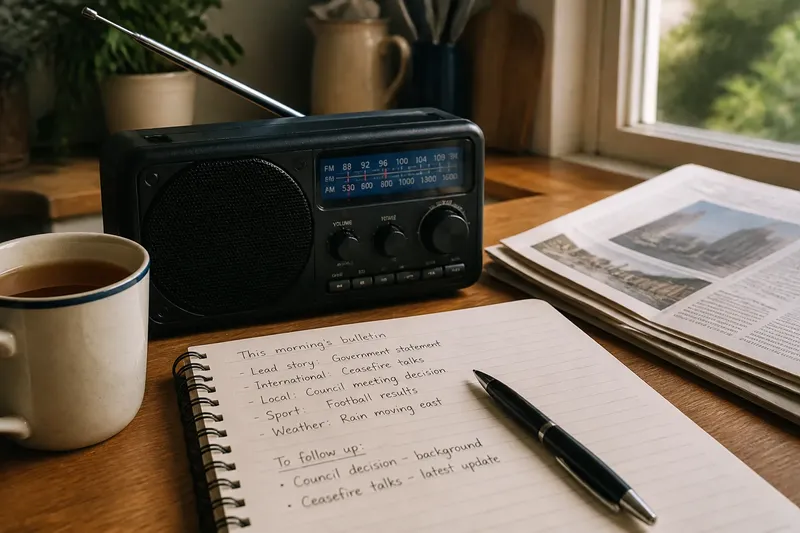
You sit down with tea just as the radio news begins: a presenter names the leading story, moves through several reports, then signals the weather and the end of the bulletin. A scheduled news bulletin gives each item a place in a fixed stretch of time, unlike a scrolling feed that keeps adding material. Its running order can make a broad mix of stories easier to follow, but it also shapes what listeners notice and what they may miss.
A bulletin turns time into an editorial structure
Editors cannot give every story the same airtime, so they arrange items into a sequence. A bulletin may open with a major development, move to other national or international news, then turn to local affairs, sport or weather. The exact pattern varies, but the order itself is a form of editorial judgement: it gives some stories earlier attention and leaves others for later.
That sequence helps a listener orient themselves. A clear opening tells you what the newsroom considers especially significant at that moment; transitions signal that the subject is changing. Since the programme has a defined end, the listener is not asked to decide which item to hear next or to keep scrolling for the next update.
Think of the running order like a tray with separate compartments. Each story has a place, and the dividers help keep one item from spilling into another. But a compartment is also a boundary: an issue given a short report may not have room for its background, competing interpretations or unresolved details.
Follow a morning bulletin as it unfolds
A routine can help you listen attentively without turning the broadcast into a test of memory. Try the following over a morning when you already plan to hear a scheduled bulletin.
- Before it starts: Settle somewhere you can listen without needing to read a screen. If you are driving or doing another task that needs your full attention, leave the news for later.
- At the opening: Notice which story leads and how the presenter introduces it. Keep the distinction between the subject and the newsroom’s choice to lead with it: one is what happened, the other is how the bulletin has arranged its agenda.
- During each item: Listen for what is reported, what remains uncertain and whether the item is a correspondent’s report, a short read by the presenter or a recorded interview. Those formats offer different amounts of explanation and different kinds of voice.
- At transitions: Pause mentally when the bulletin changes topic. Ask whether the next item is connected to the previous one or simply follows it in the schedule; sequence alone does not establish a relationship between events.
- At the close: Recall which topics received fuller treatment and which passed quickly. If one matters to you, note its name and check a later bulletin or a fuller report rather than assuming the brief item contained the whole story.
Say you hear a short report about a council meeting while making breakfast. It mentions a decision but gives little background; you note the council and the subject, then look for a fuller account after the broadcast. The useful result is not a complete record from memory, but a clear lead for finding more context.
What does the running order make easy or difficult?
Why does the lead story come first?
The lead usually marks the story the editors judge most important or urgent for that edition. It is a useful starting point, not a neutral ranking of everything happening, and another bulletin may make a different editorial choice.
Can a short item explain a complicated story?
It can give a concise account of a development, but limited airtime may leave little space for history, disagreement or detail about what is still unknown. Treat a brief report as an entry point when the subject needs more explanation.
What should I do if I miss part of the bulletin?
Use the programme’s published schedule, recording or accompanying report if one is available, and check the story’s date and update status. Avoid filling a gap in your listening with a guess about what the presenter must have said.
Does a later item matter less because it comes near the end?
Not necessarily. Placement reflects the bulletin’s editorial arrangement and available time, rather than a complete measure of a story’s importance to every listener.
The clock gives clarity but sets limits
A bulletin’s fixed duration encourages concise reporting and a recognisable rhythm. That can make it easier to hear several subjects without being pulled into an endless stream, especially when a presenter clearly marks changes and the programme distinguishes a developing story from settled information.
The same limits can flatten complicated subjects. A story may be reduced to one development, while a quieter issue receives little or no space in that edition. A scheduled programme is also a snapshot: events can change after transmission, so an item heard earlier should not automatically be treated as the latest account.
Broadcast form affects how evidence reaches the listener, too. A correspondent’s recorded report may include voices and scene-setting; a presenter’s brief read may convey only the core update. Neither format, by itself, tells you how much supporting material sits behind the account. If a detail matters, check the fuller report or the broadcaster’s accompanying material.
Use the schedule without treating it as a verdict
To follow a news bulletin well, pay attention both to the stories and to the programme’s organising choices: what opens, what gets a transition, what is compressed and what is absent. That does not require suspicion of every editorial decision. It simply keeps the running order in view as one useful frame rather than a complete map of the day.
When you return to a news bulletin, carry one question from the broadcast into your next check: what would I need to know to understand this item beyond its allotted slot? That small pause helps you benefit from the format’s clear sequence while recognising where its clock leaves the story unfinished.