A Sunday Reading Habit for Following One Continuing News Story
A Sunday reading habit for one continuing news story helps you track changes in its timeline, spot process delays and know what to check next.
You open your notes on Sunday and see that the council meeting you expected to read about has been postponed. A Sunday reading habit for one continuing news story can help you follow the process itself: what was scheduled, what happened instead, and what event comes next.
Rather than collecting every new claim, keep a simple timeline of actions and dates as reported. That makes it easier to tell the difference between a plan, a delay and a completed decision, without turning a weekly read into a second job.
Choose a story that moves through visible events
A local planning application, public inquiry or transport proposal often has a sequence you can follow: a notice, a meeting, a response and perhaps a decision. Choose one specific thread, not a broad subject such as housing or public transport.
Give it a short working name, such as “riverside planning application”. If the story later branches into a separate dispute, start a new note and link it to the original one. For urgent instructions that affect you directly, check the relevant service or organisation rather than waiting for your weekly session.
Keep a timeline of what was scheduled and what happened
Use a notebook, a notes app or a plain text file. For each entry, record the date of your reading session, the event or action described, and where the information appeared. Keep the wording neutral: “meeting postponed, according to the council notice” is more useful than “council stalls decision”.
A short timeline might include:
- Expected event: Check whether an agenda or notice names a planned meeting; if it does, record its date and source, and if it does not, leave the timing open.
- Event status: Check whether the meeting or hearing took place; if a source confirms it did, note the reported outcome, and if it was postponed or cancelled, record that instead.
- Published material: Check whether minutes, a formal notice or a decision document is available; if it is, note its title and date, and if it is not, record that you did not find it in the sources checked.
- Next scheduled action: Check for a new date or a named next stage; if one is reported, add it to the timeline, and if none is given, leave the next step unspecified.
- Change in scope: Check whether coverage now concerns a different decision or dispute; if it does, open a separate thread and link it, and if it does not, continue the existing timeline.
- Quiet period: Check whether your chosen sources report a new action; if they do not, mark “no new event reported in sources checked”, and if they do, add the event without treating silence elsewhere as proof of resolution.
Think of the timeline as a wall calendar: it shows the order of events, but it does not tell you more than the entries you have written down.
Use each Sunday session to update the sequence
Start by rereading the last entry. Then check a small number of relevant reports and, where available, the organisation’s notice, published agenda or meeting record. Look for an event that changes the sequence, not merely a fresh article that repeats the background.
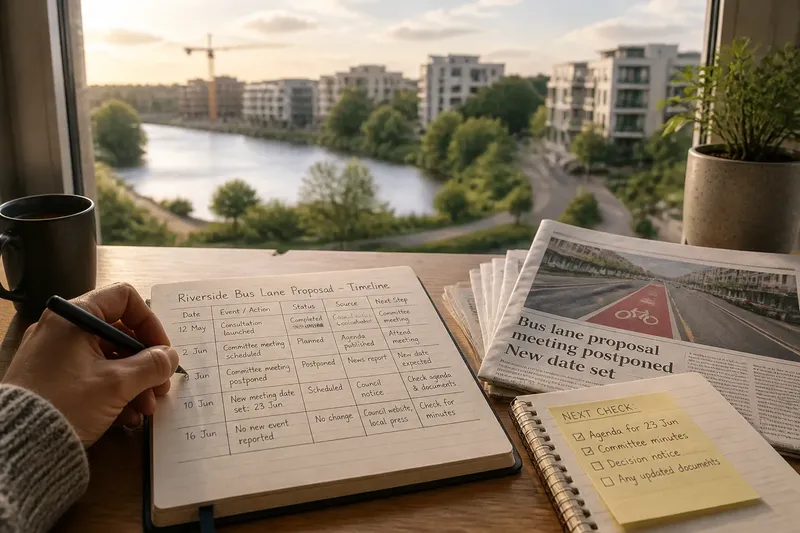
Say you are following an invented bus-lane proposal. Your note says the council opened a consultation and that a committee meeting was expected next; a new report says the meeting was postponed, while the council’s notice gives a later date. Add “meeting postponed” and the newly stated date, with the two sources named. The next entry should check whether the meeting took place and whether minutes or a decision notice appeared. This records a change in the process without treating the delay as a decision on the proposal.
How should you handle delays and quiet weeks?
What does a postponed meeting mean?
It means the planned event did not happen on the stated schedule, if that is what the source reports. It does not, by itself, show what the eventual decision will be.
What should I write when nothing new appears?
Write that no new event appeared in the sources you checked, and name those sources if useful. Do not turn a quiet week into an assumption that the matter has ended.
When should I start a separate timeline?
Start one when coverage follows a distinct event or decision that cannot be understood as the next stage of your original thread. Keep a link between the notes if the two processes remain connected.
How do I know when to stop following a story?
You can stop when a decision or final stage is documented, when the thread no longer matters to you, or when you choose not to keep checking it. Record why you stopped and what, if anything, remained unresolved in the sources you read.
Separate planned dates from completed actions
News reports may describe what an organisation intends to do, what it has scheduled, or what it has already done. Preserve those distinctions in your notes: “plans to publish”, “scheduled for the meeting” and “published” describe different stages.
When a report refers to a document or notice, follow the link if it is available. If several outlets repeat the same announcement, note the original source rather than treating repetition as a series of separate updates. If the source trail is unclear, leave that uncertainty visible.
Make the next check specific
End each entry with one event or document to look for, such as published minutes, a revised agenda or a formal decision notice. If no next event is known, write that plainly instead of inventing a date.
A Sunday reading habit for one continuing news story is most useful when it shows the order of reported actions and leaves gaps visible. A concise timeline can help you return to the story later and see what moved, what was postponed and what still has no reported next step.
Keep the original entries when you start a new thread; they preserve how the story changed shape. That small bit of housekeeping makes it easier to revisit the history without confusing an earlier plan with what eventually happened.