A Photo Caption or a Text Description? Two Routes to Context
A photo caption or text description can answer different questions: learn which to read first, what each adds, and how to treat image and words as distinct evidence.

You open a local news story on a crowded bus: the photograph shows a street blocked by water, while the text description mentions a flooded underpass. A photo caption or text description may help you place the scene, but the two do not necessarily tell you the same thing. The caption usually identifies or explains the image; the description helps people who cannot see it understand its relevant visual content.
Both are part of the story’s presentation, yet neither should be mistaken for the photograph itself or for independent confirmation of every claim around it. Which to read first depends on what you need to know: who or where, what is visibly happening, or how the image fits the report.
Choose the caption when you need names, place or timing
A caption often supplies information that the pixels cannot establish on their own. It may identify a person, give a location, explain the occasion, or state when a photograph was made. Those details can turn an unfamiliar scene into a relevant one.
Read the caption carefully for its scope. “Residents gather outside the town hall” describes a scene and location; it does not establish why each person is there, what they believe, or how many people support a particular position. A caption can also attribute a claim, such as saying that an organisation provided an estimate, without making that estimate a fact established by the image.
When names or circumstances matter, look for wording that makes the basis clear. “Shown here” signals what the photograph depicts, while “according to the council” points to a source for a statement. If a caption gives no date, the publication time alone may not tell you when the image was taken.
Choose the text description when you need the visible scene in words
A text description, often called alternative text or alt text, conveys relevant visual information in words. It is primarily there to make the image’s useful content available to readers who use screen readers or otherwise cannot see it. It may mention the main subject, an important action, or a visual detail that matters to the story.
Descriptions vary in purpose. A concise line such as “A bus stands in water on a flooded road” can communicate the central scene without listing every object in the frame. If the image is decorative or adds nothing to the story, a description may be absent or deliberately minimal.
Do not expect the description to supply the same reporting context as a caption. “A woman speaks at a microphone” describes visible content; it does not identify her, say where she is speaking, or explain the subject of the event unless those details are included. Conversely, a caption naming a speaker may leave out visual details that a description conveys.
Let your immediate question decide which to read first
If you need to identify the person, venue or event, start with the caption. If you need to understand what the image visibly contains, read the text description. If you are checking whether the image supports a sentence in the report, inspect the image if you can, then compare both pieces of accompanying text with the claim.
- You are using a screen reader: the text description is the direct route to the image’s relevant visible content. The caption can then add names, place or reporting context.
- You recognise the scene but not its significance: the caption is more likely to explain why the image appears in the story. Treat any explanation as information to assess, not as something the picture has independently confirmed.
- You are checking a specific detail: use the description for what is presented as visible, and the caption for identification or context. If the detail is central, check whether the main report explains its source.
- You are scanning a page quickly: a caption may orient you faster, but do not let its short wording stand in for the full report. A few words cannot carry every qualification or update.
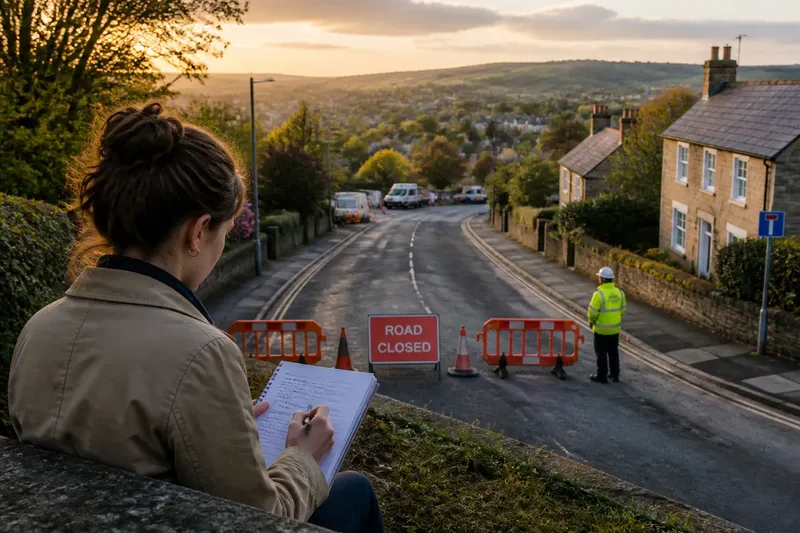
Say you are reading about a road closure and see a photograph of a barrier. The text description says a barrier blocks one lane, while the caption says it is on King Street during repairs. You can infer what the image shows and where the newsroom places it, but neither line alone tells you when the road will reopen; that answer belongs in the reporting or an official update.
Keep image and accompanying words as separate evidence
A photograph can show a moment without showing what happened before or after it. A crowd in one frame does not establish how large a wider gathering was, and a person standing near a building is not necessarily involved in an event there. The camera’s framing, timing and selection all shape what is visible.
The caption and description are also editorial choices, not transparent windows. They may be accurate and useful, but they can omit a detail, use different levels of precision, or reflect information available at publication. Think of the image and its words as two labels on a folder: each helps you find your way, but neither is the underlying record of everything that happened.
For a consequential claim, follow the story’s links to the reporting, source material or later updates. If the caption says an image shows damage after a storm, the photograph may illustrate damage; it does not by itself establish the storm’s cause, the extent of damage elsewhere, or who is responsible. Those questions require evidence beyond the frame.
What should you do when the two descriptions differ?
What if the caption and text description seem to contradict each other?
Check whether they refer to different things: a description may state what is visible, while a caption may name the location or event. If the mismatch remains, avoid choosing one as true solely because it sounds more specific; look for clarification in the story or an update.
Does a detailed caption prove that the photograph is current?
No. A caption can identify a place or event without stating when the photograph was taken. Look for an image date or explicit wording in the report, and distinguish the image’s date from the article’s publication date.
Why might a photograph have no text description?
Some images are decorative, and some pages provide image information in another way. If the visual content matters to the story but is not conveyed in text, the page may leave some readers without useful context; the caption may still offer identification or explanation.
Can a text description tell me what the image means?
It can describe relevant visual details, but interpretation and significance usually need reporting context. A description that says a person is holding a sign does not, by itself, establish the person’s role or the meaning of the event.
Read both without asking either to do the other’s job
For accessible understanding of the visible scene, begin with the text description; for names, place and why the image accompanies the story, turn to the caption. When the story’s claim matters, compare those details with the reporting rather than treating either line as a verdict.
A photo caption or text description is most useful when you know what kind of context you are seeking. Read the words for their specific contribution, notice what they leave unanswered, and keep the image itself distinct from the account built around it.