The Headline That Sounds More Certain Than the Report
Learn how to check whether a headline overstates its report by comparing its claim with the article’s qualifications, evidence and remaining uncertainty.
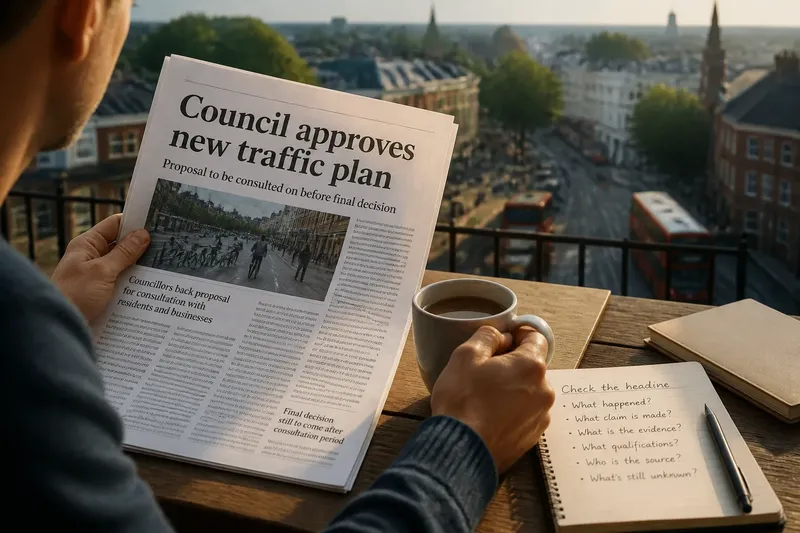
You read a headline over breakfast: “Council approves new traffic plan.” The report beneath it says councillors approved a proposal for consultation, with the final decision still to come. That gap is easy to miss when the headline is the only part you see, and it is exactly why headline certainty deserves a closer look.
A headline often has little room to explain what is provisional, disputed or conditional. Its wording can therefore sound firmer than the report itself. To judge the difference, compare the headline’s central claim with what the article says happened, what evidence supports it and what qualifications remain.
Compressed wording can turn a limited claim into a settled one
Headlines are short by design. Editors must identify the main point and make it legible quickly, often without the context that would fit naturally into a full sentence. In that compression, a careful claim can lose the words that signal its limits.
Consider the difference between “Officials consider school closures” and “Schools to close”. The second suggests a decision has been made, even if the article reports only that officials are weighing options. A headline need not be false to give a stronger impression than the report supports.
Verbs carry much of this force. “May introduce”, “plans to introduce” and “has introduced” describe different stages. So do “backs”, “proposes” and “approves”. A headline that swaps one for another can change the reader’s sense of what is known, even when the subject stays the same.
Other small choices matter, too. A headline may omit “some”, “early”, “according to the initial report” or “in one area”. Those details can mark a claim as partial or tentative. Without them, a limited finding can sound universal, or a first account can seem final.
Separate the event, the claim and the evidence
When a headline feels unusually definite, pause over three different questions. What event does the report say took place? What claim does it make about that event? What evidence or source does it offer for the claim? Keeping those questions apart helps prevent a strong headline from answering all three by implication.
For instance, a report may confirm that a medicine is being reviewed, quote a regulator describing a possible concern, and say that no decision has been announced. The event is the review; the concern is an attributed claim; the outcome remains unknown. A headline that says “Medicine declared unsafe” would collapse those distinctions.
This is not a reason to distrust every headline. It is a way to read its wording in proportion to the report. If the article clearly supports a firm claim, the direct phrasing may be fair. If the body repeatedly limits the claim, the headline deserves a second look.
Think of the headline as the label on a folder and the report as the papers inside. A label helps you find the subject, but it cannot replace checking what the documents actually say. The useful question is not simply whether the headline sounds confident; it is whether the report earns that confidence.
Match certainty to the report’s language
Read the first few paragraphs, then scan for phrases that narrow or qualify the claim. Look for wording such as “according to preliminary figures”, “officials have not confirmed”, “the proposal would”, “researchers say more evidence is needed” or “the cause is under investigation”. These are not decorative caveats: they set the boundaries of what the article can responsibly state.
Next, compare those boundaries with the headline. Ask whether the headline turns a possibility into an outcome, a proposal into a decision, or one person’s account into an established fact. Also notice whether it makes a local development sound broader than the report describes.
Say you see a headline reading “New rule bans wood burners”. Imagine the report explains that a council has proposed restrictions in certain new developments and has not yet voted on them. The observable mismatch is between “bans”, which sounds settled and general, and the report’s narrower, pending proposal; a more faithful headline would name the proposal and its limited scope.
Pay attention to who is making each claim, but keep that separate from whether the headline overstates it. An official’s statement, a witness account and a confirmed event are not interchangeable forms of support. The report may present them carefully while the headline compresses away the distinction.
It can also help to ask what would make the headline accurate. Would a formal decision be needed? Confirmation from another source? Evidence that the claim applies beyond one location? If the article says those conditions have not been met, its own wording may tell you that the headline has moved ahead of the evidence.
Check how attribution and uncertainty survive compression
Attribution identifies who is speaking or making a claim. A headline such as “Minister says food prices may rise” signals both a source and uncertainty. “Food prices set to rise” removes the speaker and strengthens the prediction. The report may explain that the minister is describing a possibility, not announcing a settled forecast.
That shift can happen without a headline writer deliberately misleading anyone. A short line has to carry the news quickly, and an editor may assume that readers will open the report for nuance. Yet many people encounter only the headline, so a missing qualifier can meaningfully alter the impression it leaves.
Look for a mismatch in scope as well as certainty. If the report describes a change affecting a particular service, group or district, check whether the headline sounds as though it applies to everyone. Words such as “all”, “nationwide” or “the public” need support in the text, just as firm verbs do.
When the report itself is unclear, avoid filling the gap with certainty of your own. A headline and article can both leave a question unresolved. That does not prove the underlying claim is false; it means the available account does not yet settle it.
What does a cautious headline actually signal?
Does “could” mean the event is likely?
No. “Could” signals possibility, not likelihood on its own. Check whether the report gives a reason for the possibility and whether it describes a plan, a forecast or only a scenario.
Is a headline wrong if it leaves out a qualification?
Not automatically; a short headline cannot carry every detail. But if the missing qualification changes the claim’s scope or makes an unresolved matter sound settled, the wording may mislead even if individual words are technically accurate.
Should I read beyond the first paragraph?
Yes, when the distinction matters or the opening does not explain the headline’s confidence. Find the passage that supports the central claim and note any later correction, limitation or unresolved point.
What if the report and headline use different verbs?
Compare what each verb says has happened: “proposed” is not “approved”, and “is reviewing” is not “has ruled”. If the article supports only the weaker description, treat the stronger headline as an interpretation rather than a settled account.
Keep the headline’s confidence in proportion
After checking, you do not need to replace one confident impression with another. You can hold a more precise view: the report confirms a proposal, attributes a forecast to an official, or describes an event whose cause remains unclear. That phrasing preserves what is known without pretending the gaps have disappeared.
When sharing a story, include the qualification if it changes the meaning. “The council is considering the plan” is more informative than repeating “Council approves plan” when no final vote has taken place. A small adjustment in wording can help the next reader distinguish an early account from a settled decision.
The next time a headline sounds unusually certain, use the article’s own qualifications as a measure. Compare the claim, the evidence and the stage of events, then describe only what the report supports. That habit makes headline reading more accurate without asking you to assume either that every bold line is true or that every bold line is suspect.